
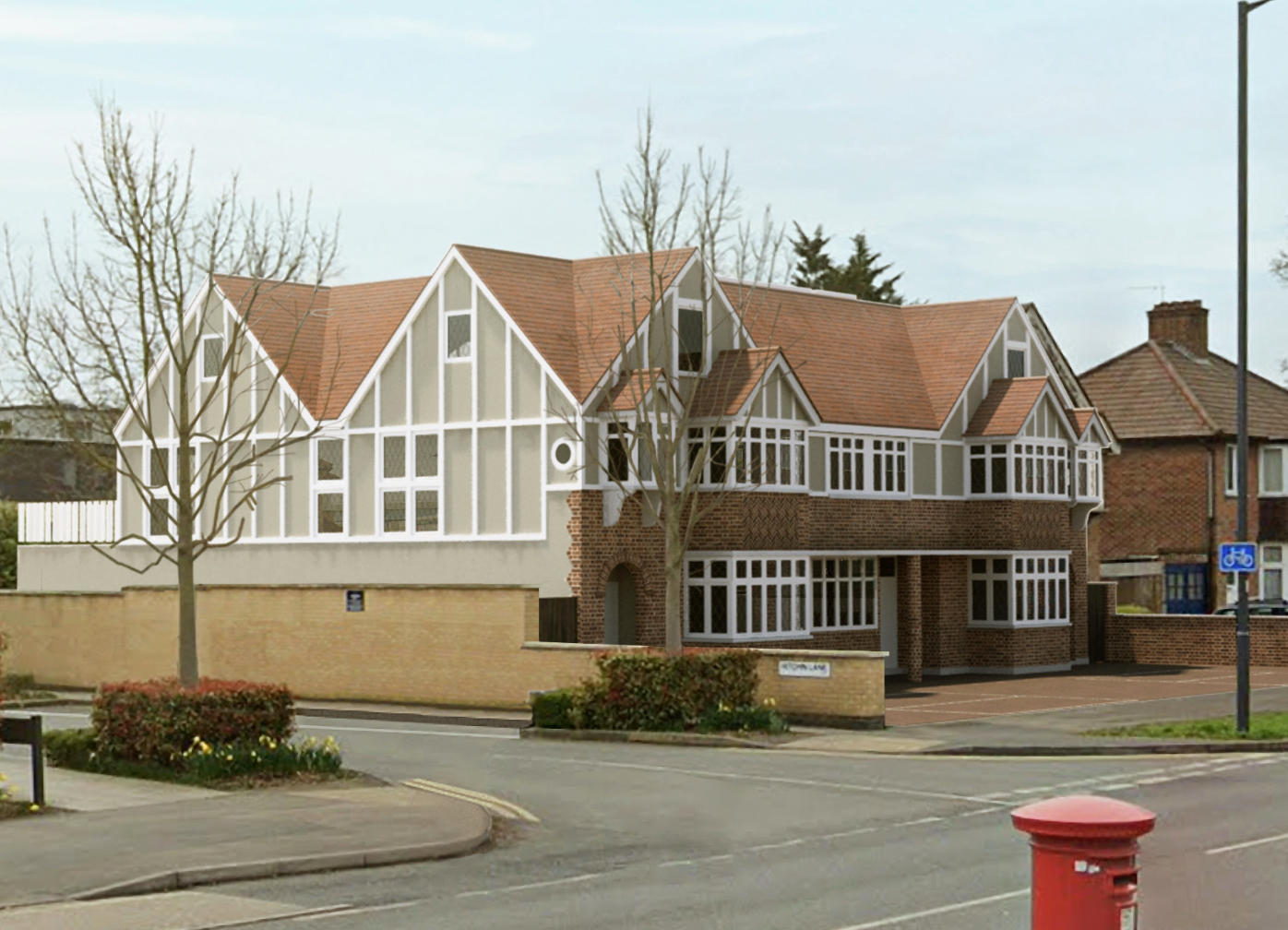
Whitchurch Lane
Planning Case Study
280 & 282 Whitchurch Lane, Edgware – 8 Flats Approved After Earlier Refusal and Appeal Dismissal
Overview
We secured a resolution to grant planning permission in Harrow for the extension and conversion of 280 & 282 Whitchurch Lane, Edgware to provide 8 flats: 1 x 1-bed, 6 x 2-bed and 1 x 3-bed. The application was recommended for approval at committee earlier this year, subject to the completion of a Section 106 agreement.
This was not an easy site.
A broadly similar redevelopment had already been refused and then dismissed at appeal around 10 years earlier. That earlier scheme proposed 9 flats and was rejected on broad design, massing and overdevelopment grounds.
The reason this scheme succeeded was not that the site suddenly became easy. It was that the planning position was rebuilt carefully over time.
The strategy involved securing fallback development rights for both houses first, using those rights to change the baseline, then working closely with the architect to shape a more robust scheme and keep pushing it through a long and resistant process until it reached committee.
For more information on our work in the borough, visit our Harrow planning consultant page.
The Site
The site comprises two 1930s detached houses at the corner of Hitchin Lane and Whitchurch Lane in Edgware, within a predominantly residential area. The site also sits opposite Station Parade, with a moderate to good PTAL and close access to local services and public transport.
That context mattered.
This was not a remote suburban plot with no nearby services. It was a site with a reasonable level of accessibility and a location that could support a more intensive residential use, provided the design and massing were handled properly. The final proposal connected the two houses into a single building by extensions and converted them into flats, with amenity space, parking, cycle storage and landscaping.
The Planning Challenge
The main challenge was the history.
The committee report records that a larger redevelopment of the site for 9 flats was refused in December 2012 and dismissed at appeal in January 2014. The refusal reason cited overdevelopment, encroachment into private rear garden areas and harm to the character and appearance of the locality.
That meant this was never going to be a simple case of submitting a fresh application and hoping for a different answer.
There was also a second challenge: prolonged officer resistance and a protracted process. Public-facing, the important point is not to overstate that, but to be clear that this required a long-haul strategy, not a one-shot application.
Strategic Approach
This scheme worked because the strategy was staged and disciplined.
1. Change the planning baseline first
Before the main flat conversion scheme, fallback rights were secured for both houses.
The committee report confirms:
prior approval not required decisions for 8m rear extensions to both houses in 2019, and
lawful development certificates for side and rear extensions to both houses in 2020.
That was a key move.
It meant the later planning application was not being assessed against the original unextended houses alone. The planning position had already shifted. In practical terms, much of the built envelope was already capable of being delivered under permitted development.
That is what changed the conversation.
2. Work the design and strategy together
This was also a genuinely collaborative scheme with the architect.
The job was not simply to comment on drawings after the fact. It was to shape the route to consent by aligning planning strategy and design development over time.
That matters particularly on a site like this, because the historic refusal was essentially a broad “we do not like this form of development here” refusal. The only way through that is to improve the scheme strategically and architecturally at the same time.
3. Keep pushing for more meaningful engagement
This did not move quickly.
The site had a difficult history, multiple rounds of pre-application engagement and a long process. The crucial point here is that the strategy was not passive. It involved continuing to push for better-quality engagement and continuing to move the application forward when a lot of people would probably have backed off.
That is often what difficult sites require: not just a better drawing set, but a better process strategy.
4. Take it to committee and get it over the line
Ultimately, the committee report concluded that the current scheme was acceptable on the key issues of design, residential amenity, highways, flood risk, fire safety and biodiversity, and recommended that planning permission be granted subject to the legal agreement.
That is what makes this such a strong result.
A site with a failed planning history did not just get revisited. It was turned around.
Outcome
A resolution to grant planning permission was secured in Harrow for the extension and conversion of 280 & 282 Whitchurch Lane to provide 8 flats.
This was a strong result because:
a similar redevelopment had already been refused and dismissed at appeal,
the planning position had to be rebuilt carefully over time,
fallback rights were secured first,
the architect and planning strategy had to work together,
and the scheme still had to be pushed through a long and resistant process before it reached committee and secured approval.
Project Data
Borough: Harrow
Location: 280 & 282 Whitchurch Lane, Edgware HA8 6QX
Proposal: Extensions and conversion of two detached houses into 8 flats
Approved mix: 1 x 1-bed, 6 x 2-bed, 1 x 3-bed
Key issue: Failed planning history overcome through staged strategy and fallback rights
Decision: Committee approval subject to Section 106 agreement